

Quick Summary
A newborn clothing checklist starts with the number of outfit changes per day, multiplied by how many days pass between laundry loads, plus four to six extra outfits. Families who wash every two to three days need roughly 10 to 14 bodysuits and sleepers, while weekly washers need 18 to 24 pieces across all categories.
- Washing every 2 to 3 days needs about 10 to 14 bodysuits and sleepers.
- Washing once a week calls for 18 to 24 pieces across all categories.
- Humid or hot climates need 30 to 50 percent more clothing for sweat and spit-up.
- Flatlock or overlock seams lie flat and reduce friction against delicate skin.
- Two-way zippers let you change diapers without exposing the baby's chest.
Table of Contents
- How Many Newborn Clothes Do I Need? Quantities by Laundry Frequency
- Newborn Clothing Essentials: The Core Checklist
- Newborn Clothes by Season: Adjusting Layers for Your Climate
- Best Fabrics for Newborn Clothes and Skin Considerations
- Safe Sleepwear, Sizing Strategy and When to Skip Newborn Sizes
- Building a Newborn Capsule Wardrobe Without Overbuying
- Choosing Your Starter Pieces Before the Baby Arrives
- Frequently Asked Questions
9 Essential Newborn Clothes to Buy in 2026
Last Updated: October 28, 2026
How Many Newborn Clothes Do I Need? Quantities by Laundry Frequency
A newborn clothing checklist can help with planning. The answer depends on how often you plan to wash. A family doing laundry every two days needs far fewer outfits than one that waits a week.
A practical starting point is to count outfit changes per day. Multiply that by the number of days between laundry loads, then add a buffer of four to six extra outfits.
Consider these rough planning ranges:
- Washing every 2 to 3 days: 10 to 14 bodysuits and sleepers
- Washing once a week: 18 to 24 pieces across all categories
- Humid or hot climates: add 30 to 50 percent more for sweat and spit-up
A smaller wardrobe can be a practical starting point. Compare durable newborn clothing brands recommended in practice, see which brands hold up best.
The number of pieces you need depends on how often you wash, as summarised below.
| Laundry frequency | Planning range | Note |
|---|---|---|
| Every 2 to 3 days | 10 to 14 bodysuits and sleepers | Fewest outfits needed |
| Once a week | 18 to 24 pieces across all categories | All categories combined |
| Humid or hot climates | Add 30 to 50 percent more | For sweat and spit-up |
Newborn Clothing Essentials: The Core Checklist
Start with the pieces you will use every day. The core checklist covers bodysuits, sleepers, socks, and hats.
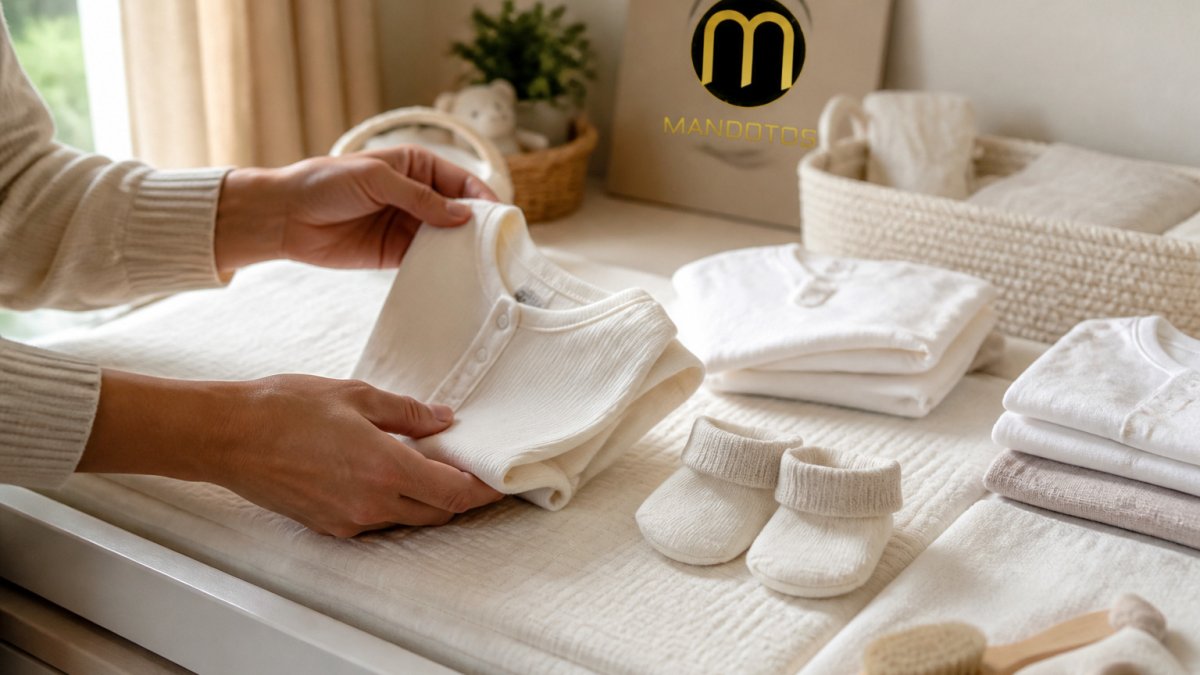
!A new parent's hands folding a soft cotton bodysuit and small socks on a neutral nursery changing table, natural window light
Bodysuits and Onesies
Our Bunny Ear Baby Onesies are 100% premium cotton, machine washable, and sized from 0-3 months to 12-18 months. For a longer-sleeved one-piece, the Baby jumpsuit romper newborn outfit is sized from 3M through 12M, with a chest measurement listed for each size.
Check the size chart before buying. The product listings note that measurements can vary by about 2 to 3 cm depending on how the piece is measured.
Sleepers, Sleep Gowns and Pajamas
Sleepers are the pieces most parents reach for at night. Look for simple closures and fabric that stays soft after repeated washing. Avoid loose items that could work up during sleep.
Infant Baby Ruffles Jumper Solid Long Sleeve Set, Boys Girls 2Pcs Fall Outfit →
Socks, Booties, Mittens and Hats
The Newborn Soft Shoes feature a soft sole and a secure fit designed to stay on, with sole lengths of 11 cm for size 12 (0-6 months) and 13 cm for size 13 (6-12 months).
Newborn Clothes by Season: Adjusting Layers for Your Climate
A long-sleeve set, such as the Infant Baby Ruffles Jumper Solid Long Sleeve Set (a two-piece fall outfit with a sweatshirt top and pants, cotton main fabric, sized 80 to 110 cm), works well for cooler days.
Best Fabrics for Newborn Clothes and Skin Considerations
- Seams: Flatlock or overlock seams lie flat against the skin and reduce friction. Avoid raised, thick seams inside the garment, especially at the shoulders and sides.
- Tags: Look for tagless labels or printed labels. If a tag is present, cut it out carefully, do not tear it, which can leave a scratchy edge.
- Closures: Snaps or a two-way zipper make diaper changes faster, especially at night. A two-way zipper lets you open only the bottom for a change without exposing the chest. Avoid buttons and snaps that are loose or small enough to detach.
- Fit: A snug fit is safer for sleepwear and reduces bunching under other clothes. Check that the neckline stretches easily over the head but returns to shape, and that cuffs are soft and not tight.
- Stretch: A small amount of elastane (spandex) in the cuffs and neckline helps the garment go on and off without losing shape after washing.
Fabric also affects how often you can wash. Cotton holds up to frequent washing, but check care labels: some cotton pieces shrink in hot water.
Many of the items in our range use cotton, which makes them a sensible default. When in doubt, choose the simpler construction: fewer seams, softer closures, and breathable fabric.
Safe Sleepwear, Sizing Strategy and When to Skip Newborn Sizes
Our Bunny Ear Baby Onesies and romper sizing start at 0-3 months and 3M.
Building a Newborn Capsule Wardrobe Without Overbuying
A capsule wardrobe is a small set of pieces that mix and match. For a newborn, it means choosing neutral colors and simple designs so that every piece works with the others.
- 6 to 8 bodysuits in matching colors
- 4 to 6 sleepers
- 2 to 3 sets for cooler weather
- 2 pairs of socks and 1 pair of soft shoes
- 2 hats and 1 pair of mittens
Choosing Your Starter Pieces Before the Baby Arrives
A focused newborn clothing checklist covers the basics without filling the closet. Start with the essentials, track what gets worn, and refill as needed. That approach keeps the wardrobe useful and avoids the waste of unused pieces.
Frequently Asked Questions
What clothes does a newborn need for the first few weeks?
For the first few weeks, a newborn mostly needs bodysuits or onesies, sleepers or sleep gowns, a few soft hats, socks or booties, and a swaddle or sleep sack. Bodysuits keep the tummy covered under sleepers, and the open-front design makes changes quick. Plan for roughly 6 to 8 bodysuits and 5 to 7 sleepers in a newborn size, then adjust based on how often you do laundry. Add a coming-home outfit that is comfortable rather than tight, since car seats and swaddles already add bulk.
How many newborn outfits should I buy?
Most families need around 8 to 10 bodysuits, 6 to 8 sleepers, 3 to 4 hats, and 4 to 6 pairs of socks or booties. The exact number depends on laundry frequency. If you wash every two or three days, a smaller stock works; if you wash less often, buy more. Newborns can go through several outfits a day during feeds and diaper changes, so having a few spares is practical. Avoid buying large quantities in one size, since babies can outgrow newborn clothes within weeks.
Should I buy newborn or 0-3 month clothes?
Buy a mix of both if you can. Newborn-size pieces fit babies at birth, but many newborns are larger or smaller than average and grow quickly. Many parents find 0-3 month sizes fit well from the first weeks, especially for sleepers and bodysuits with stretch. Check the size chart on each product, because sizing varies between styles. Buying a small number of newborn pieces and building the rest in 0-3 months is usually the most economical approach.
What fabrics are best for newborn clothes?
Our Bunny Ear Baby Onesies are 100% premium cotton and machine washable. Check the product listing for care instructions.
